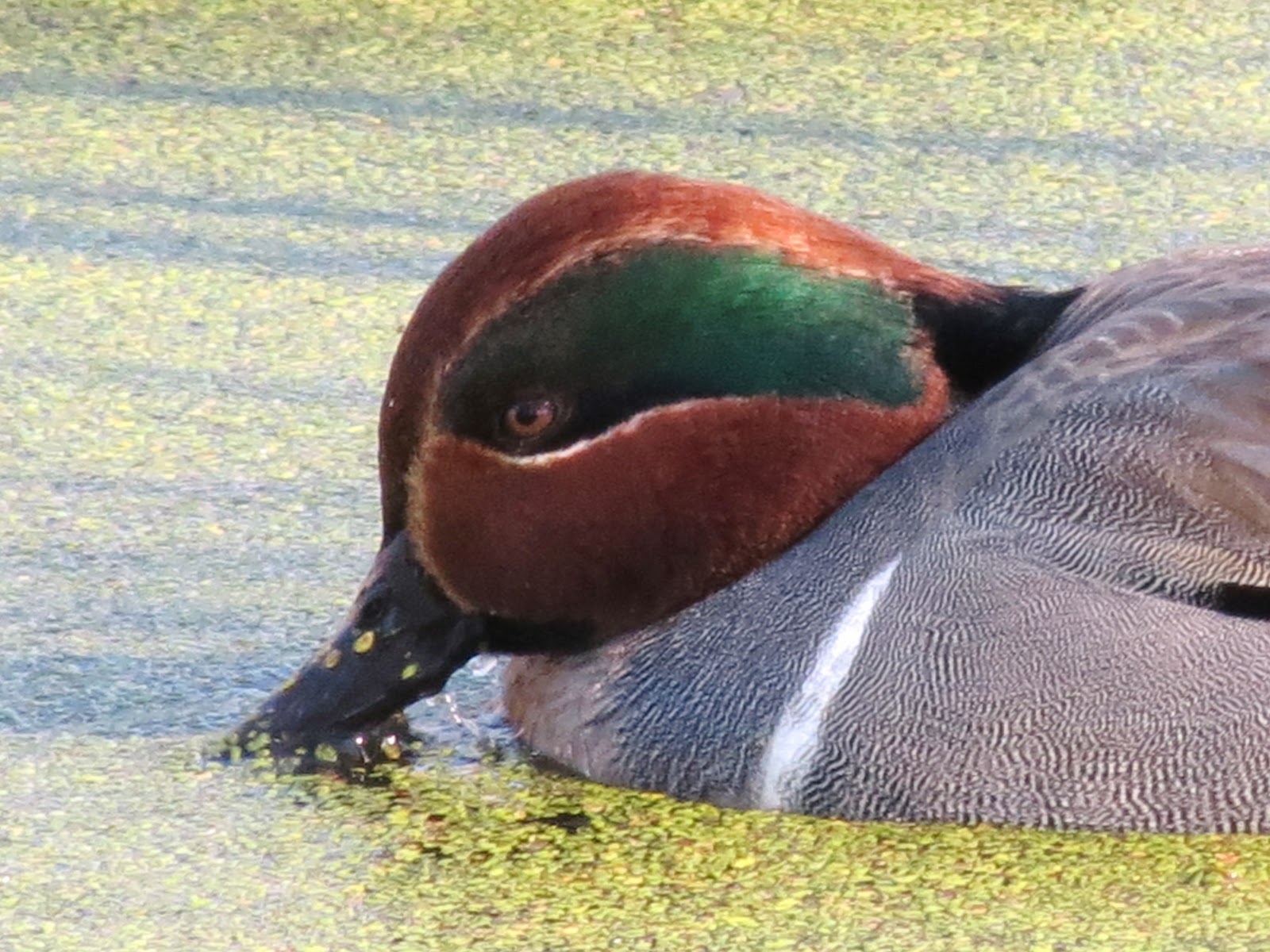
It's always exciting for me to see and photograph new birds and ducks. And that was the case earlier in January when I encountered many Green-Winged Teal at Magnolia Plantation's Audubon Swamp.

The male is quite a striking fellow with his green and crimson head.
The female Green-winged Teal (below) doesn't have the flamboyant head but does have a lovely wing pattern.

According to one of my favorite online bird resources WhatBird.com, this duck is native to northern Alaska, Canada, California, Colorado, Nebraska, and New York. They winter in the South and annually find their way to the ponds of Magnolia Gardens, as the signs there indicate.

On this visit to the Audubon Swamp, it was also neat seeing another type of Teal- the Blue-winged Teal. Two males and a female are pictured below.

Also native to Northern locales, the male Blue-winged Teal has that distinctive white band down its face. I have seen these before in ponds at the old Kings Grant golf course in Summerville and more recently at the Savannah National Wildlife Refuge (look for an upcoming posting on that outing).
In the shot below you see Green and Blue-winged Teals mixed together.

Below, a pair of male Blue-winged Teals. I read on another Internet site that Blue-Winged Teals are generally the first ducks south in the fall and last north in the spring.
The Audubon Swamp waters were, in fact, full of winter ducks on this day! Even better, though it was winter, the temperature was very pleasant in the 60s and the skies were a lot clearer than the water!
Another colorful duck in the crowd I spotted was the American Wigeon.
This wintering wild fowl can be mistaken (at least by me anyway) for the Green-winged Teal but upon closer inspection the green of the Wigeon is a different pattern on the head and its beak is mostly white unlike the Teal's dark one.
The American Wigeon was formerly known as "Baldplate" because the white stripe on its crown resembles a bald man's head (WhatBird.com). If I was this duck, I'd like the name Wigeon better too!
Here's a male and female Baldplate, err, American Wigeon.
The cute little Pied-billed Grebe was also present in the busy Audubon Swamp at Magnolia Gardens.
The Pied-billed Grebe is not classified as a duck because it doesn't have webbed feet. The bird has incredible range, being found throughout North and South America. Despite its sweet face it has a number of ferocious folk names such as devil-diver, hell-diver, and water witch.
My visit to Magnolia Plantation and Gardens also included bird sightings in the trees, such as a pair of Turkey Vultures.
The Turkey Vulture's red face makes it distinct from its close relative, the Black Vulture. But someone does need to see the dermatologist about that white yukky stuff around the eyes!
Look what else I spotted high up a tree! A Raccoon. See its face in the left side of the photo.
I know you're trying to hide from me Raccoon, but I see you up there!
Notice too that long crevice in the tree that looks to be filled with one or more little coons. Look at the bottom part of this photo below the mother's tail.
One of the smaller birds I photographed was the Yellow-rumped Warbler.
I made sure to get a picture of the Yellow-rumped's yellow rump.
Eastern Kingbirds were also hanging around the swamp.
I have photgraphed the Kingbird in other area locations and have been struck by how this bird, unlike most other small birds, will stay still even around people, allowing for good photographs to be taken. Well, it is king after all!
Really good winter birding here at the Audubon Swamp at Magnolia Plantations and Gardens. In the spring, you can see nesting Great Blue Herons, Great Egrets and other large coastal birds in the sanctuary's rookery.
A very relaxing, rewarding outing here for a modest admission fee. I'll be back!
And, oh yeah, you can pay the full entrance fee and also tour the vast, beautiful and historic Magnolia Plantation and Gardens.