Wednesday, November 24, 2010

Osprey

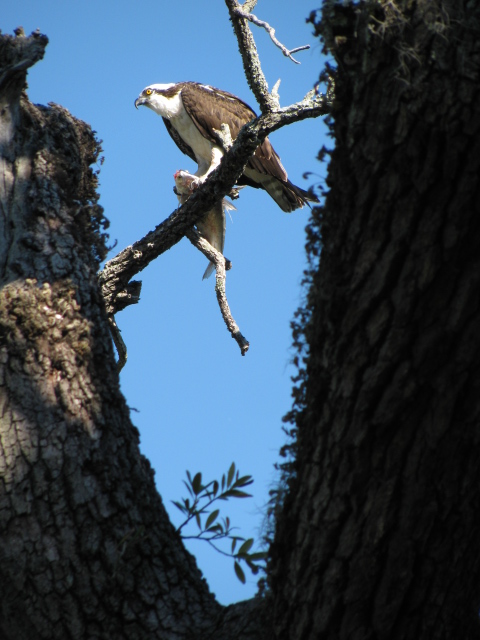
I had an incredible encounter with an Osprey recently! 
I've photographed Osprey before but never from this close. The large fish it is clutching in its right claw seemed to make it less willing to fly off as Osprey usually do when they catch site of humans from much greater distances.
                            
Going eye-to-eye with the regal Osprey like this is a nature/bird photography highlight for me.
Osprey are also known as Fish Hawks.  Another reason this one stayed put with me staring straight up at it from the ground below, I think, is because it was calling out to is partner to come share in the fish feast.
                         
With big, brilliant and bright eyes and a sharp, can opener of a beak the Osprey is well-equipped for successful fishing.
I was glad to get a shot like this that showed the wings in full extension- six feet plus-- as tall as I am!
                                               
       This chance encounter was the chance of a lifetime- one I may never get again, so I'm happy to get the images I did.  Live long and prosper Osprey!

Saturday, November 13, 2010

Hooded Mergansers


December 10, 2010: Posted the above new photo taken today.  There are now a couple dozen Hooded Mergansers at Charleston's Magnolia Cemetery.

This small duck has such a striking look.
The Hooded Merganser has returned to the Magnolia Cemetery ponds for the fall and winter. The male sports distinctive white patches bordered by black on his paper-thin head. The female doesn't have the patch but instead more an orange tinge to her head.
Affectionately called "Hoodies," these ducklike birds spend most of the year north in Canada, Alaska and the Great Lakes region.  In November the past two years I've noticed them locally at Charleston's Magnolia Cemetery. 
They are the cutest little things don't you agree?  Cute yes, but not so little.  They are 16-19 inches long so a bit big for your bathtub!  A smaller Hoodie rubber ducky would work though. 
They're called "Hooded" Mergansers because they have a crest at the back of their heads that can be expanded or contracted.  The female (above left) is in hooded mode. 
View from behind a Hoodie. The white on the wings nicely complements the other white markings giving the bird an artsy, almost toylike look.
Hoodies are quite active and social. The males' mating and masculine antics can be very animated.  According to Reader's Digest's "Book of North American Birds":  They swim circles around females and if ignored too much will leap vertically from the water and execute a perfect somersault.  She's got to at least give him style points for effort."  I've yet to personally see such a leap but hope I will sometime!

The Hoodies' eyes seem too tiny for their big heads.  But observant and quick they are.  They notice even my stealthiest efforts to get closer and quickly change directions...away from me.

The Meganser's will likely stay here in the South until March or so before flying back to their Northern ranges.
So we'll enjoy them while they are in our area! 
As it gets cooler here, just where your hoodie and go see these Hoodies. 
For more on this unique and sport bird, go to this site or this one: http://identify.whatbird.com/obj/390/_/Hooded_Merganser.aspx
Sunday, October 31, 2010

Double-Crested Cormorants

This unsual looking bird is called a Double-crested Cormorant.  I'm surprised to learn there are some 40 species of Cormorants in the world.  The Double-crested in the most common type in the U.S.

There are many things distinctive about the Cormorant.  Its bill, blunted or hooked at the tip, helps separate it from the somewhat similar Anhinga.  This Cormorant is called Double-crested for the feathered tufts on its head, which are not easy to spot.
The Cormorant has webbed feet and is quite a swimmer. It can stay underwater and catch fish and other marine critters.

The name ‘Cormorant’ has been derived from the Latin words ‘Corvus Marinus’, which means ‘marine crow’ or ‘sea raven’. Cormorants are also known as shags in some parts of the world.

Cormorants are fun to watch especially when drying themselves after a swim.  And they don't seem as skiddish toward humans as other big birds I've encountered.
Awkwardly regal-- that's the Double-crested Cormorant. Armed with its own can opener beak to crack  crustaceans and mollusks.

Unusual eyes too on the Cormorants!  Took these photos at Charleston's Magnolia Cemetery in October 2010.  By the way, a flock of Cormorants is called a "gulp."  Another odd fact about this odd bird.
Added these next two shots in November 2010

Sunday, October 17, 2010

Green Herons

What a delight to discover this small bird at Magnolia Cemetery recently.  The Green Heron, also called the Green-Backed Heron, is the smallest of the Heron family measuring just 18-22 inches.  Compare that size to the Great Blue Heron which stands 50-54 inches tall. The Greenie is the runt of the Heron family!
I guess the more you take pictures, you'll get a nice surprise now and then.  I didn't see the Dragonfly when I took this shot.  What a thrill when I got home, viewed my photos and, wow, found this shot!  I liked this image so much I had a mid-size canvas reproduction made at Imaging Arts Gallery and Fine Art Printing on King Street in Charleston.
 Love trying to get- and getting- good reflection shots like this. 
 The Green Heron has a minnow in its mouth.  Note its large feet. 
It was such a thrill to meet this new bird (for me) and be able to photograph it for several minutes like this from fairly close range.  Thanks to my birding friends Sal and Suzanne for their help in identifying the Green Heron for me. 
I ran into another Green Heron just last week.  My bird book says when alarmed the bird will raise the spiky black feathers on its crown.
This is the same bird, just moments before.  Didn't mean to alarm you my little friend.  You can ask that other Green Heron I photographed previously-- I'm harmless!

Monday, October 11, 2010

Wood Storks

Normally when I see Wood Storks they are up in trees or flying so this was a thrill to see several together in a pond at Magnolia Cemetery this summer. 

This Wood Stork is a strangely beautiful bird, don't you think?
The Wood Storks are quite magnificant in flight, with full wing extension


Treetop chillin'!

Wood Storks- it was these magnificant creatures that got me into birding!

Sunday, October 3, 2010

Snowy Egrets

Elegant and petite, Snowy Egrets are always fun to see.  Their yellow "slippers" make them easy to recognize.  Plus they are much smaller (but just as great!) as the Great Egret. 
It's often possible to get pretty close to this bird.  It's very intense when hunting/fishing and doesn't seem to notice or mind a human slowly getting closer.
The Snowy Egret's dark bill is also distinctive from the Great and Cattle Egrets which have yellow bills.
A pond at Magnolia Cemetery in Charleston offers the fish and frogs the Snowy craves. Snowy's will eat snakes too. I don't see snakes at the cemetery-- at least on land.
Below are a couple of my favorite Snowy Egret photos, taken at Magnolia Cemetery in July 2010.
They are just so photogenic! It's as if they are posing for the camera, holding nice and still with excellent posture too!
Snowy Egrets- just a lovely coastal bird that I feel fortunate to be able to frequently see around the South Carolina Lowcountry.