This week I had a really fun outing at one of the South Carolina Lowcountry's wildlife management areas. Bear Island is south of Charleston near Green Pond, S.C. It consists of more than 12,000 acres of wetlands, tidal marsh, woodlands and agricultural areas. Much of the property was used for rice cultivation (with slaves) back in the 1700s and 1800s.
These Double-crested Cormorants were one of nearly 20 bird species I photographed during my visit. Note the duck blind in the background. The reserve is open to hunting and fishing certain times of the year. My coolest bird discovery on this day was one I have never seen before. When I came up this particular dike in the farthest back of Bear Island the bird was flying. The way it skimmed the surface of the water for food my first thought was this could be a skimmer. My trusty small bird book I always keep in my car confirmed this to be a Black Skimmer. A most unusual-looking creature.
This Skimmer's lower mandible is much longer than the upper one. In fact, this is the only bird in North America with such a feature that enables its superior scooping action in the water. It looks kind of awkward on the ground with its short legs and odd beak but in the air skimming it's quite a beautiful bird to behold!
I didn't get a sharp picture of it flying this time. Hope to run into the Black Skimmer again and get a better flying shot.
Had to laugh when I learned that a group of Skimmers goes by these names: a "conspiracy", "embezzlement", and "scoop." Scoop I get but the other names seem sinister!
You see a lot of straight narrow canals like this at Bear Island and other Lowcountry nature parks. This one particularly had bird (and alligator) activity which included a second new species discovery for me: the Black-necked Stilt.
Among its many distinctions, the Black-necked Stilt has the second-longest legs in proportion to its bodies of any bird, exceeded only by the Flamingo. (
WhatBird.com)
Yep, the leggy Stilt is well named.
Quite a photogenic bird though both on the ground, in the water and in the air.
Miles of hiking can be done here along the many paths amid a series of water impoundments still controlled, as they were in the heyday of "Carolina Gold" rice, by wooden trunks.
This visitor's efforts were rewarded by many surprises coming upon colonies of birds or individual ones, or other animals such as deer, raccoons, rabbits and gators.
June proved to be a good time to visit Bear Island. I enjoyed quite a bit of bird activity including this grouping of coastal favorites.
From left, we have a Wood Stork, four Snowy Egrets and a Great Egret.
I thought the Wood Stork looked out of place but then that's a neat thing about nature: how birds of different species often do interact and exist together so, well, naturally.
A Tri-colored Heron also showed up for this little party.
This was another interesting grouping I encountered on an unsual wooden structure in the middle of one of the many ponds or impoundments. I'm saying Royal Tern for the larger birds and Forster's Tern for the smaller black eye marked birds.
Getting back to the Tri-colored Heron. I watched this one coiled like a snake poised to snag a tasty treat. It moved with purpose around this spot, striking here then there. Look at the intensity!
ACE Basin planners would surely applaud the ample ecosystem they have fostered.
A Green Heron also prowls for food, which seems to be abundant here for our feathered friends.

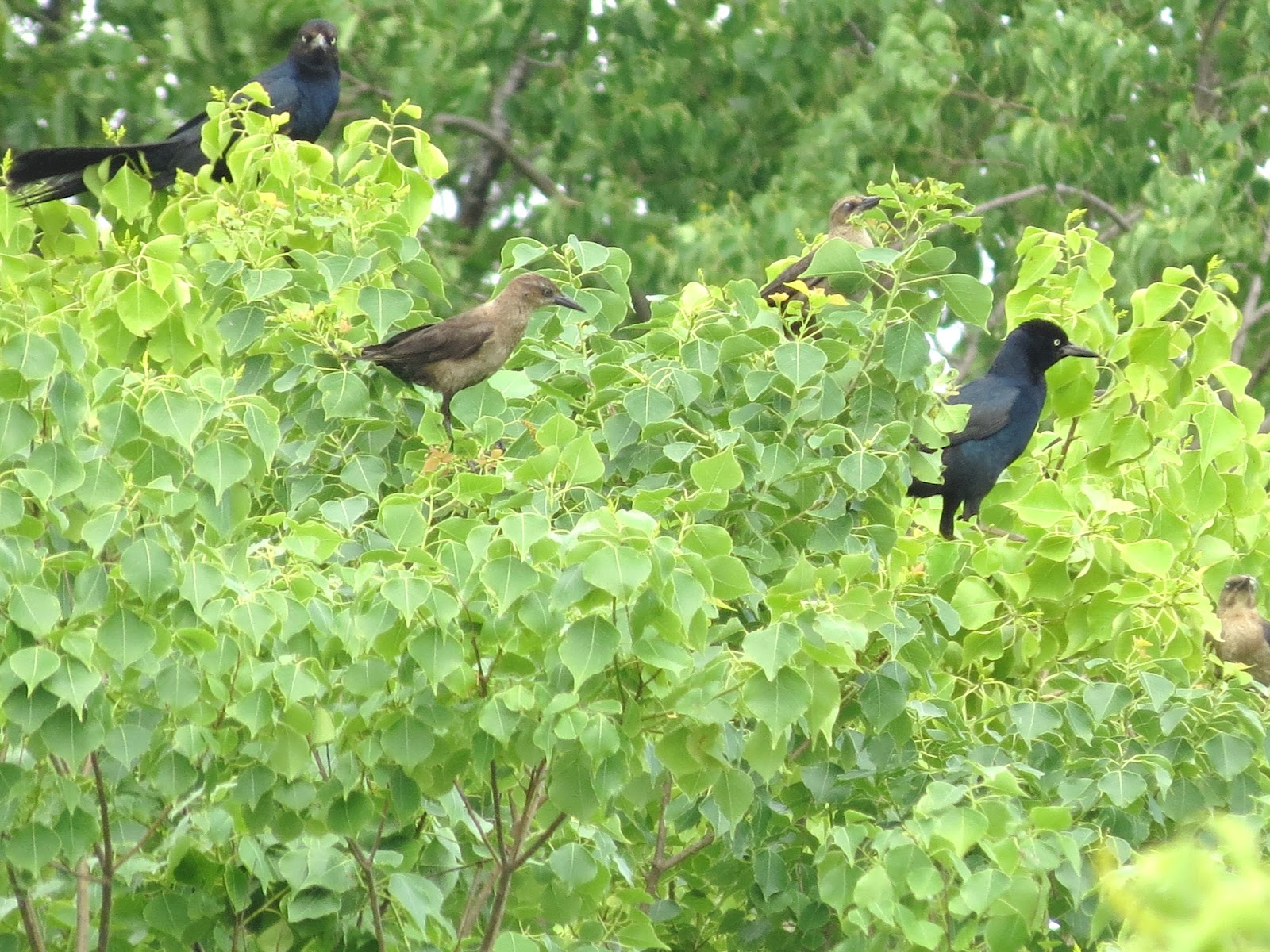
These large birds also caught my eye, the Boat-tailed Grackle. You see both the dark male and the female that is more brown. I thought these may be Great-tailed Grackles but some fellow posters on WhatBird.com convinced me otherwise...
I saw this Grackle in another location snag a crunchy meal.
A female (left) and male Anhinga high atop a tree with what must be an amazing view of Bear Island and beyond.
An Anhinga in flight.
Red-winged Blackbirds were, by far, the most abundant bird I saw on this day.That's the female in the background.
Up close and personal with a Red-winged Blackbird. I'm determined to eventually get a really good photo of this striking bird flying so that you can really see its fabulous red wings in action.
The bugs were pretty bad on this June day. I'm glad this Northern Mockingbird kept at least one off me!
I'm bullish on Bear Island. Lots of parts I did not see this visit. I hope to get back soon, before it gets too much hotter.

My car seemed to have a good time too, especially when I parked it in the shade of Spanish Moss.

For more information on the Bear Island Wildlife Management Area see this website:
A Great Egret looking, as always, so great!