Last Monday I had a very nice "staycation" outing back to the Santee Coastal Reserve Wildlife Management Area north of McClellanville, S.C.
It was warm day and very buggy on some pathways along the 24,000 acre nature site. But my friend Beverly Donald and I came away with some excellent photographs. The clouds were gorgeous, enhancing wide shots like the ones below.
Love this photo!
Showing posts with label Patrick Harwood blog. Show all posts
Sunday, August 2, 2015
Sunday, December 16, 2012
Successful Saturday Signing! And a Lifer Bird Too!
My Saturday, Dec. 15 book signing went really well! Thanks to those who came out and bought my Birds of Magnolia Cemetery book. It's always nice to meet fellow bird and nature lovers! Thanks also to the cemetery's super superintendent Beverly Donald for making this event possible!
My next signing is this Wednesday, Dec. 18 at the College of Charleston. I'll have a table on Cougar Mall in front of the Robert Scott Small building from noon- 2. Call or text me at 843.224.3112 if you need help with directions.
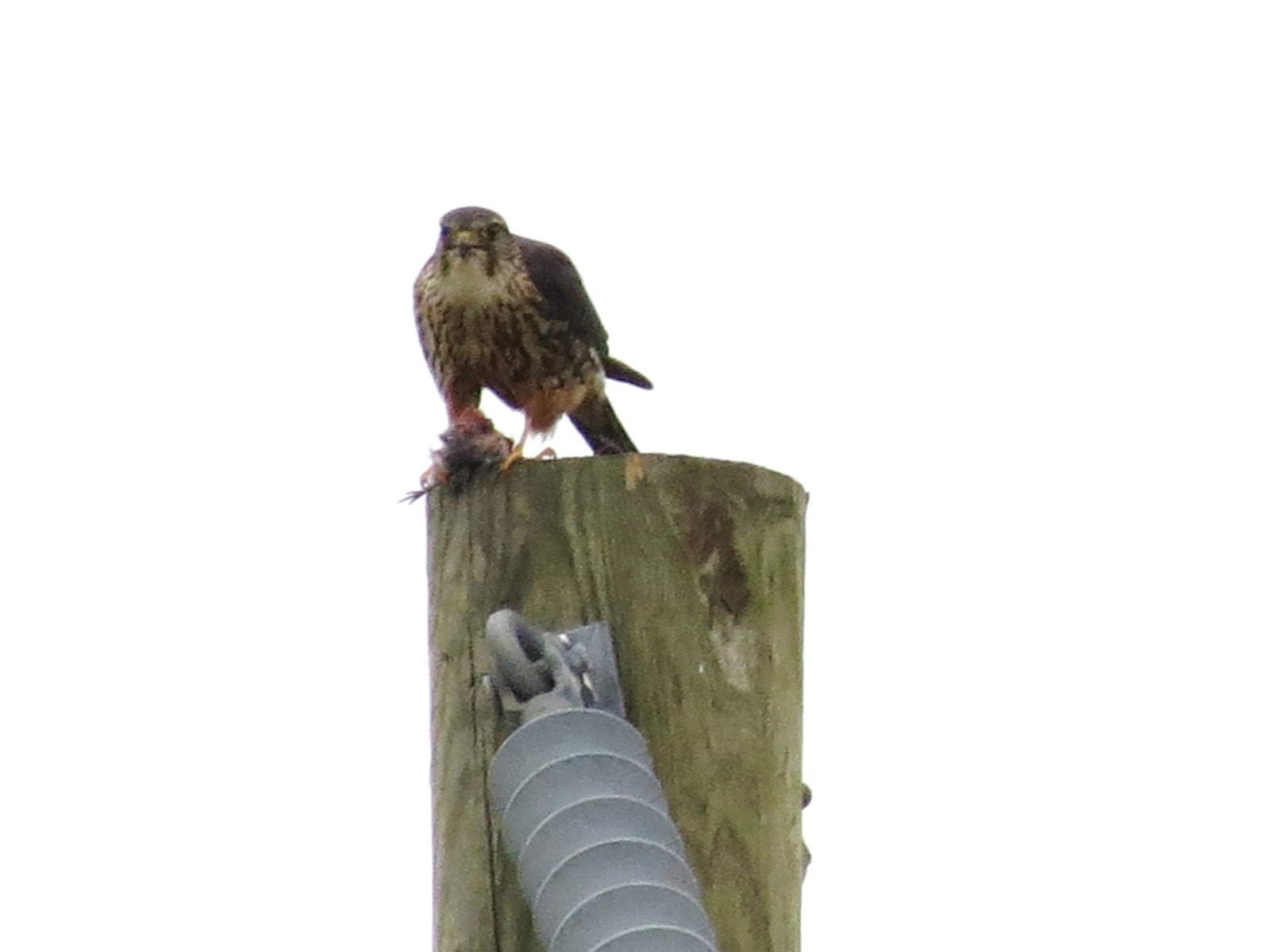
You know I never go to Magnolia Cemetery without my camera. And I'm sure glad I did as I scored some nice photos of a Merlin (which I originally thought was a Hawk). Merlins are members of the Falcon family.
Through my lens and binoculars it was hard to tell what the Merlin had caught and was eating. It wasn't until I got home and viewed the shots on my television and computer that I determined it was a bird. The Audubon Field Guide online confirms that Merlins feed mostly on small birds captured in high-speed mid-air pursuit. That is what Falcons are known for.
OK last carnage shot, not trying to gross out people!
I am updating this post in July 2024. I came across these photos and this old post while this summer updating my "Birds of Magnolia Cemetery" book. Pretty cool to discover a "lifer" bird 12 years after the fact!
Saturday, March 26, 2011
Little Blue Heron
New Little Blue Heron Photos
I went back to the old Kings Grant golf course and came across what I'm pretty sure is the same juvenile Little Blue I photographed there several weeks ago. You can see how its color is changing, from all white (see below photos) to, eventually, all dark blue. I plan to go back in coming weeks in hopes to see this heron again as its maturing process continues.
I shot the above photo in my cameras Vivid setting. Almost looks like a watercolor!
Previous Posting
I was planning to next feature, as part of my recent heron spree, the Great Blue. But last weekend I had a really neat encounter with a couple Little Blue Herons, so I decided to share these pictures first.
The Little Blue Heron is yet another of the Heron species that can be scene regularly in South Carolina's Lowcountry. I took these photos at what used to be a golf course near my home. This site has yet to be redeveloped and is returning to nature in many ways-- not a bad thing at all! I went back to the old Kings Grant golf course and came across what I'm pretty sure is the same juvenile Little Blue I photographed there several weeks ago. You can see how its color is changing, from all white (see below photos) to, eventually, all dark blue. I plan to go back in coming weeks in hopes to see this heron again as its maturing process continues.
I shot the above photo in my cameras Vivid setting. Almost looks like a watercolor!
Previous Posting
I was planning to next feature, as part of my recent heron spree, the Great Blue. But last weekend I had a really neat encounter with a couple Little Blue Herons, so I decided to share these pictures first.
The Little Blue is much darker than other Herons. Its purplish neck is also distinctive as is its black-tipped bill. Its also smaller than many of the other Herons.
The big surprise for me at the old golf course was enountering an immature Little Blue which is more than a little white. When getting these shots, I wasn't sure what kind of bird I was seeing here. Looked little a Snowy Egret some but when it moved I wasn't seeing the Snowy's bright yellow "slippers." Later at home I looked at my pictures and a few of my bird books. It was then I noticed the same black-tipped bill as the adult Little Blue.
So this outing proved a first for me in that I had never seen a juvenile Little Blue Heron before.
The Little Blue Heron is the only heron species in which first-year birds and adults show dramatically different coloration: first-year birds are pure white, while adults are blue. (source Cornell University's All About Birds website).
And quite a transformation it is!
Labels:
Little Blue Heron,
Patrick Harwood blog
Sunday, March 6, 2011
Tricolored Heron
I'm continuing my Heron run on BirdsEyeViews. My last two postings have been the Yellow-crowned Heron and the Black-crowned Heron. Now it's the Tricolored Heron's turn.
This bird is also or used to be called- depending on what you read- the Louisiana Heron.
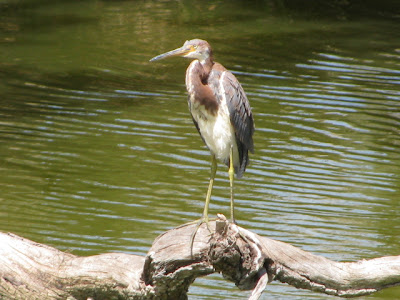
What distinguishes the Tricolored from other Herons is its whte belly and the white stripe down the front of its neck.
In the photo below, you see the Tricolored (right) next to a Little Blue Heron. It's easy to differentiate between the two when you see them side-by-side like this.
I really like this next photo that captures, in a single frame, four of the most common coastal birds seen in South Carolina's Lowcountry. From left, the Great Egret, Snowy Egret, Great Blue Heron and the Tricolored Heron. This photo was taken, as are many of mine, at Charleston's Magnolia Cemetery.
This next photo, I believe, is a juvenile Tricolored Heron. The juvenile or immature one is described as similar to the adult, but more reddish.
Note the size of this young Tricolored's "feet."
I was curious about the Louisiana Heron name for this bird. With some research, I've found the name goes back at least as far back as the 1830s when the legendary naturalist, painter and birder John J. Audubon himself wrote about seeing them in Florida. Somewhere over the years the more bland name of Tricolored was adopted. Can I presume it's for the blue, gray and white colors of the adult? Please do correct if I am wrong on that point.
I've been focusing on all of the different types of Herons to be seen in my area. And the one that's really most common, I have yet to feature: the Great Blue Heron, the mightiest and most majestic of them all. That will be my next posting. But let me finish this one with a couple more Tricolored (Louisiana!) Heron shots.Gotcha!
What a lovely and graceful bird is the Tricolored Heron!
Sunday, February 13, 2011
Yellow-Crowned Night-Heron
Added this new photo taken in April 2011 at Magnolia Cemetery- a Yellow-Crowned Night Heron launching into flight.
My last post was on the Black-Crowned Night Heron. This time the focus is on the Black's close but very different-looking relative: the Yellow-Crowned Night Heron.
The Yellow-Crowned is a species I have only seen a couple times. 
The above two photos were taken in September 2009. The one below I took in Spring 2010. Both are at Charleston's Magnolia Cemetery, an excellent (and little known...so shhh!) birding spot.

The above two photos were taken in September 2009. The one below I took in Spring 2010. Both are at Charleston's Magnolia Cemetery, an excellent (and little known...so shhh!) birding spot.
When you see this bird, you know it's something different, one you don't see every day.
The Yellow-Crowned is considered more active during the day than its close relative, the Black-Crowned Night Heron (which I feature in the post prior to this one)
It's a striking, beautiful bird with large piercing orange eyes and with the namesake yellow stripe on its head or crown.
According to Wikepedia, the Yellow-Crowned Night Heron is called the American Heron and the Squawk.I had my Yellow-Crowned encounter at Charleston's old and historic (and isolated) Magnolia Cemetery, located near the Cooper River. The cemetery has two ponds surrounded by live oaks and other trees that attract numerous types of birds.
Of late, a family of Black-Crowned Night-Herons has been calling the cemetery home. The Yellow-Crowned hasn't been around but I do look forward to future encounters, wherever they may take place. The Yellow-Crowned, such a stately, magnificent member of the illustrious Heron family!
New Photos Added: March 26, 2011. Wow, a pair of Yellow-Crowned Herons in the same shot!
These Yellow-Crowned Herons were in the same tree as some Black-Crowned Herons. I didn't realize these were Yellow-Crowned until I got home and really examined my pix. The back coat of the Yellow helped me realize these weren't Blacks. Take a look at the pair of Blacks below, then the Yellows above. This was definitely a birding first for me- Yellow and Black-Crowned Herons together in the same tree just one big happy family!
Sunday, December 26, 2010
Winter Backyard Birds
Pine Warblers have been among the winter visitors to my backyard feeders. Many thanks to Tammy Sanders of Charlotte who gently corrected my earlier misidentification of this bird as an American Goldfinch. Two Chipping Sparrows are in the background.

The Pine Warbler is a new bird to me. According to some reference material, it is in South Carolina year-round but I can't recall seeing it in my backyard until this winter.

The White-breasted Nuthatch is another new discovery this winter in my backyard. This bird really likes to go upside-down!
The smaller Downy Woodpecker has been a mainstay this winter. I like the claw detail captured in this photo.
The cute Tufted Titmouse is one of the most common birds I see. But common doesn't mean that I take them for granted!

The Titmouse and Carolina Chickadee often hang out between feeds in holly shrubs next to my backyard patio.

The Chipping Sparrow is a winter visitor to coastal South Carolina. Its found more inland in the Southeast and Deep South.
The Carolina Chickadee is a chirpy active bird and a common site around my house.


The Black-capped version has narrow white edges on on its wing feathers that the Carolina doesn't have.

I'll be interested to see who else shows up this winter. The food and water will be out for all comers.
Pretty cool having some snow today. The birds seemed to like it too!
The Pine Warbler is a new bird to me. According to some reference material, it is in South Carolina year-round but I can't recall seeing it in my backyard until this winter.
The White-breasted Nuthatch is another new discovery this winter in my backyard. This bird really likes to go upside-down!
I hadn't seen this bird before. At first, I thought it was the Carolina Chickadee. But the Nuthatch is much larger and is striking and stylish in its black and grey coloring.
The Nuthatch just about drove me nuts trying to photograph. They are quite flitty, never staying put but for a few seconds. But I got a few decent photos.
A third newcomer to my yard also took some bird book and online investigation. Meet the Dark-eyed Junco. This snowbird, also called the Northern Junco, spends the rest of the year up North, as far away as Canada.
The Junco's white/pink beak caught my attention first, then its clearly separated dark top half of its body and its white bottom half. This bird likes to graze for food on the ground, and didn't fly up to my feeders.
Northern Mockingbirds are common in my area but not in my backyard. But recently they've been regulars at my feeders. I've never really seen this bird up close. Doing so reveals its cool eye pattern, the dark straight line through its eye reminds me of war paint. This probably works for the aggressive, fiesty Mockingbird when it attacks larger birds, as it's known to do.
At my feeders, the Mockingbird is a perfect "gentleman." It shows no aggression toward the other bird breeds. Maybe because they are usually much smaller?
Red-bellied Woodpeckers are year-round in my area. These colorful birds are not above swooping down to my feeders at least a few times a day.The smaller Downy Woodpecker has been a mainstay this winter. I like the claw detail captured in this photo.
The cute Tufted Titmouse is one of the most common birds I see. But common doesn't mean that I take them for granted!
The Titmouse and Carolina Chickadee often hang out between feeds in holly shrubs next to my backyard patio.
The Carolina Wren is South Carolina's state bird. Back in June, I did a posting about a crowded Carolina Wren nest in a bird house hanging from my front porch: http://mybirdseyeviews.blogspot.com/2010/06/carolina-wren-nest.html
Thanks again to Tammy Sanders for identifying the above bird as a Chipping Sparrow. It's similar somewhat to the Carolina Wren but the black line through its eye is a clear distinction, among others. The Chipping Sparrow is a winter visitor to coastal South Carolina. Its found more inland in the Southeast and Deep South.
You may be more familiar with the Black-capped Chickadee. I know I was and thought that's what I was seeing. Only later did a discover that our region has its own Carolina Chickadee.
The Black-capped version has narrow white edges on on its wing feathers that the Carolina doesn't have.
I'll be interested to see who else shows up this winter. The food and water will be out for all comers.
ADDED DECEMBER 26, 2010
A rare snow in the Charleston area this afternoon. Bird activity as busy as ever, if not more frenetic.
A Pine Warbler feeds away amid the snow flurry. A rare snow in the Charleston area this afternoon. Bird activity as busy as ever, if not more frenetic.
Pretty cool having some snow today. The birds seemed to like it too!
Subscribe to:
Posts (Atom)