Sunday, October 31, 2010

Double-Crested Cormorants

This unsual looking bird is called a Double-crested Cormorant.  I'm surprised to learn there are some 40 species of Cormorants in the world.  The Double-crested in the most common type in the U.S.

There are many things distinctive about the Cormorant.  Its bill, blunted or hooked at the tip, helps separate it from the somewhat similar Anhinga.  This Cormorant is called Double-crested for the feathered tufts on its head, which are not easy to spot.
The Cormorant has webbed feet and is quite a swimmer. It can stay underwater and catch fish and other marine critters.

The name ‘Cormorant’ has been derived from the Latin words ‘Corvus Marinus’, which means ‘marine crow’ or ‘sea raven’. Cormorants are also known as shags in some parts of the world.

Cormorants are fun to watch especially when drying themselves after a swim.  And they don't seem as skiddish toward humans as other big birds I've encountered.
Awkwardly regal-- that's the Double-crested Cormorant. Armed with its own can opener beak to crack  crustaceans and mollusks.

Unusual eyes too on the Cormorants!  Took these photos at Charleston's Magnolia Cemetery in October 2010.  By the way, a flock of Cormorants is called a "gulp."  Another odd fact about this odd bird.
Added these next two shots in November 2010

Sunday, October 17, 2010

Green Herons

What a delight to discover this small bird at Magnolia Cemetery recently.  The Green Heron, also called the Green-Backed Heron, is the smallest of the Heron family measuring just 18-22 inches.  Compare that size to the Great Blue Heron which stands 50-54 inches tall. The Greenie is the runt of the Heron family!
I guess the more you take pictures, you'll get a nice surprise now and then.  I didn't see the Dragonfly when I took this shot.  What a thrill when I got home, viewed my photos and, wow, found this shot!  I liked this image so much I had a mid-size canvas reproduction made at Imaging Arts Gallery and Fine Art Printing on King Street in Charleston.
 Love trying to get- and getting- good reflection shots like this. 
 The Green Heron has a minnow in its mouth.  Note its large feet. 
It was such a thrill to meet this new bird (for me) and be able to photograph it for several minutes like this from fairly close range.  Thanks to my birding friends Sal and Suzanne for their help in identifying the Green Heron for me. 
I ran into another Green Heron just last week.  My bird book says when alarmed the bird will raise the spiky black feathers on its crown.
This is the same bird, just moments before.  Didn't mean to alarm you my little friend.  You can ask that other Green Heron I photographed previously-- I'm harmless!

Monday, October 11, 2010

Wood Storks

Normally when I see Wood Storks they are up in trees or flying so this was a thrill to see several together in a pond at Magnolia Cemetery this summer. 

This Wood Stork is a strangely beautiful bird, don't you think?
The Wood Storks are quite magnificant in flight, with full wing extension


Treetop chillin'!

Wood Storks- it was these magnificant creatures that got me into birding!

Sunday, October 3, 2010

Snowy Egrets

Elegant and petite, Snowy Egrets are always fun to see.  Their yellow "slippers" make them easy to recognize.  Plus they are much smaller (but just as great!) as the Great Egret. 
It's often possible to get pretty close to this bird.  It's very intense when hunting/fishing and doesn't seem to notice or mind a human slowly getting closer.
The Snowy Egret's dark bill is also distinctive from the Great and Cattle Egrets which have yellow bills.
A pond at Magnolia Cemetery in Charleston offers the fish and frogs the Snowy craves. Snowy's will eat snakes too. I don't see snakes at the cemetery-- at least on land.
Below are a couple of my favorite Snowy Egret photos, taken at Magnolia Cemetery in July 2010.
They are just so photogenic! It's as if they are posing for the camera, holding nice and still with excellent posture too!
Snowy Egrets- just a lovely coastal bird that I feel fortunate to be able to frequently see around the South Carolina Lowcountry. 


Sunday, September 26, 2010

Vultures!

A summer fish kill at Charleston's Magnolia Cemetery attracted...what else?  Vultures! 
The two types of Vultures-- Turkey (above) and Black (below) were present and accounted for.  The Black Vulture shares a branch with some Wood Storks.
There's no mistaking the differences between the two types of Vultures.  The Turkey one has the red head.  This one has some weird stuff going on around its eyes. 
The Wood Storks didn't mind the Vultures being around. The Black Vulture's wingspan is around five feet.  The Wood Stork's is a bit larger at five and a half feet.
I read this about Vultures:  "Decay is their ally, softening the bodies of large animals so that they can be picked clean."  I'm not touching the cemetery anologies!
"But an old carcass can be a messy meal, and so it is that the vulture's head is naked, unfeathered-- not pretty perhaps, but beautifully suited to the way this hardworking bird makes its living." (Quotes are from the Reader's Digest "Book of North American Birds")
Vultures-- nature's clean up crew.

Sunday, September 19, 2010

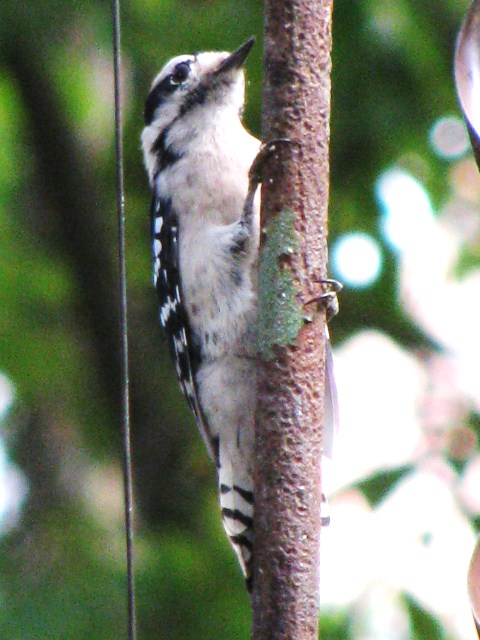
Downy Woodpeckers

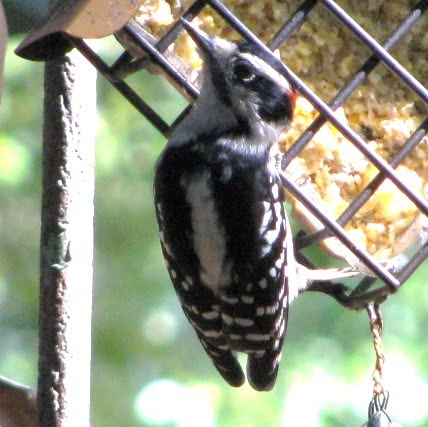
December 2010- I added these two photos of a male Downy Woodpecker taken recently in my backyard. The Downy is one of my favorite backyard birds.  I've put out extra suet and this large food block, which they really take to. 
Thus is the best closeup shot I've taken to date capturing the male's distinctive red spot.  What I like about the Downy too is they're not as skiddish as many other birds.  I was maybe eight feet away when I took these, standing out in the open.  It knew I was there and didn't fly away.  Gotta like that!
Previous Posting:
For weeks now I've been trying hard to get down with the Downy Woodpeckers that visit my backyard for the suet I keep out there. 

They find the suet quite tasty and are back and forth on my three set ups numerous times daily.
I must admit I sought help from birding friends in identifying this small salt and pepper bird.  I had never heard of the Downy Woodpecker species, thinking this couldn't be a 'pecker because it is so small. 
I became especially intrigued by the Downy when I began noticing the red spot on the male's head. 
I like the "W" on the back of this guy's head-- "W" as in Woodpecker I guess!
I've been setting a chair behind an azalea shrub to try to stay hidden but there have been occasions when I've been even closer and more open and the Downy still comes down for a treat

It has just a little, bitty mouth!

The Downy Woodpecker has been a very challenging litte bird to photograph.  I've deleted many, many out-of-focus, poorly lighted pix.  Patience and persistience have been needed to get down with the Downy! 
Unique bird this Downy Woodpecker.  Keep coming around my yard.  I'll make sure there's always suet for you!  October 2010- Just added the photo below.  A Downy Woodpecker in my backyard and a golfer in the background. 

For more on Downy Woodpeckers check this cool site: http://identify.whatbird.com/obj/177/_/Downy_Woodpecker.aspx