Saturday, March 26, 2011

Little Blue Heron

New Little Blue Heron Photos
I went back to the old Kings Grant golf course and came across what I'm pretty sure is the same juvenile Little Blue I photographed there several weeks ago.  You can see how its color is changing, from all white (see below photos) to, eventually, all dark blue.  I plan to go back in coming weeks in hopes to see this heron again as its maturing process continues.
I shot the above photo in my cameras Vivid setting.  Almost looks like a watercolor!
Previous Posting
I was planning to next feature, as part of my recent heron spree, the Great Blue.  But last weekend I had a really neat encounter with a couple Little Blue Herons, so I decided to share these pictures first.
The Little Blue Heron is yet another of the Heron species that can be scene regularly in South Carolina's Lowcountry.  I took these photos at what used to be a golf course near my home.  This site has yet to be redeveloped and is returning to nature in many ways-- not a bad thing at all! 

The Little Blue is much darker than other Herons.  Its purplish neck is also distinctive as is its black-tipped bill.  Its also smaller than many of the other Herons. 
The big surprise for me at the old golf course was enountering an immature Little Blue which is more than a little white. 

When getting these shots, I wasn't sure what kind of bird I was seeing here. Looked little a Snowy Egret some but when it moved I wasn't seeing the Snowy's bright yellow "slippers."  Later at home I looked at my pictures and a few of my bird books.  It was then I noticed the same black-tipped bill as the adult Little Blue.

So this outing proved a first for me in that I had never seen a juvenile Little Blue Heron before.
 The Little Blue Heron is the only heron species in which first-year birds and adults show dramatically different coloration: first-year birds are pure white, while adults are blue. (source Cornell University's All About Birds website).
And quite a transformation it is!


Sunday, March 6, 2011

Tricolored Heron

I'm continuing my Heron run on BirdsEyeViews. My last two postings have been the Yellow-crowned Heron and the Black-crowned Heron. Now it's the Tricolored Heron's turn.

This bird is also or used to be called- depending on what you read- the Louisiana Heron.

What distinguishes the Tricolored from other Herons is its whte belly and the white stripe down the front of its neck. 
In the photo below, you see the Tricolored (right) next to a Little Blue Heron.  It's easy to differentiate between the two when you see them side-by-side like this.
I really like this next photo that captures, in a single frame, four of the most common coastal birds seen in South Carolina's Lowcountry.  From left, the Great Egret, Snowy Egret, Great Blue Heron and the Tricolored Heron.  This photo was taken, as are many of mine, at Charleston's Magnolia Cemetery.
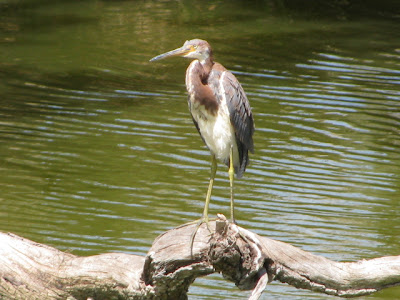
This next photo, I believe, is a juvenile Tricolored Heron.  The juvenile or immature one is described as similar to the adult, but more reddish.
Note the size of this young Tricolored's "feet."
I was curious about the Louisiana Heron name for this bird.  With some research, I've found the name goes back at least as far back as the 1830s when the legendary naturalist, painter and birder John J. Audubon himself wrote about seeing them in Florida. Somewhere over the years the more bland name of Tricolored was adopted.  Can I presume it's for the blue, gray and white colors of the adult? Please do correct if I am wrong on that point. 
I've been focusing on all of the different types of Herons to be seen in my area. And the one that's really most common, I have yet to feature: the Great Blue Heron, the mightiest and most majestic of them all. That will be my next posting. But let me finish this one with a couple more Tricolored (Louisiana!) Heron shots.
Gotcha!                      

What a lovely and graceful bird is the Tricolored Heron!

Added this photo on March 13, 2011-- A few days ago I photographed this Tricolored on a windy day.  A gust would really show off the plume that is usually pretty flat against the back of its head and neck.

Sunday, February 13, 2011

Yellow-Crowned Night-Heron

Added this new photo taken in April 2011 at Magnolia Cemetery- a Yellow-Crowned Night Heron launching into flight.
My last post was on the Black-Crowned Night Heron.  This time the focus is on the Black's close but very different-looking relative:  the Yellow-Crowned Night Heron. 
The Yellow-Crowned is a species I have only seen a couple times. 
The above two photos were taken in September 2009.  The one below I took in Spring 2010. Both are at Charleston's Magnolia Cemetery, an excellent (and little known...so shhh!) birding spot. 
When you see this bird, you know it's something different, one you don't see every day. 
The Yellow-Crowned is considered more active during the day than its close relative, the Black-Crowned Night Heron (which I feature in the post prior to this one)
It's a striking, beautiful bird with large piercing orange eyes and with the namesake yellow stripe on its head or crown.
According to Wikepedia, the Yellow-Crowned Night Heron is called the American Heron and the Squawk.
I had my Yellow-Crowned encounter at Charleston's old and historic (and isolated) Magnolia Cemetery, located near the Cooper River.  The cemetery has two ponds surrounded by live oaks and other trees that attract numerous types of birds. 
Of late, a family of Black-Crowned Night-Herons has been calling the cemetery home.  The Yellow-Crowned hasn't been around but I do look forward to future encounters, wherever they may take place. The Yellow-Crowned, such a stately, magnificent member of the illustrious Heron family! 
New Photos Added: March 26, 2011.  Wow, a pair of Yellow-Crowned Herons in the same shot!
These Yellow-Crowned Herons were in the same tree as some Black-Crowned Herons.  I didn't realize these were Yellow-Crowned until I got home and really examined my pix.  The back coat of the Yellow helped me realize these weren't Blacks.  Take a look at the pair of Blacks below, then the Yellows above. 
This was definitely a birding first for me- Yellow and Black-Crowned Herons together in the same tree just one big happy family!

Sunday, January 23, 2011

Black-Crowned Night Heron


The mysterious Black-Crowned Night Heron is an unusual looking creature that is rare to come across.

I know it doesn't-- but it occurs to me:  Does this bird have a little penguin in it???

A Black-Crowned Night Heron party in a tree at Charleston's Magnolia Cemetery.
To me the adults have two distinctive characteristics:  those blazing red eyes and the long black strip along its head and back, hence the black-crowned moniker. Below: In flight- the Black-Crowned Night Heron

The Black-Crowned Night Heron is considered medium-sized (23-28 inches long), stocky, short necked.

Notice the white plumes on the above left heron.  The male and female aduts are considered identical as far as appearance from a distance.

This bird does its feeding at night, thus the "night" part of its name.  During the day, they can be seen and seem active only when flying away from me and my camera!

Another interesting thing about the Black-Crowned Night Heron is how the young ones or juveniles look so much differently than their parents.  They do share the red eyes (above). They go through some major transformation to eventually take on the black and white look of the adult. 

The juvenile (below) resembles the American Bittern.  But the different eye color helps differentiate the two. 

I've followed this family of Black-Crowned Night Herons for a few months now at Charleston's Magnolia Cemetery.  They have been enjoyable to observe and challenging to photograph.  They do readily mix with other species such as the White Ibis below, and with a Brown Pelican in the photo after that.

Photo (below) an adult Night Heron shares a pond tree with several Ibis, including some jueveniles of that breed
Black-Crowned Night Herons- for more about this cool customer, see WhatBird.com