Tuesday, May 17, 2011

Red-Shouldered Hawk

I recently had a neat experience with a pair of Red-Shouldered Hawks at what used to be a golf course near where I live.  The golf course (Kings Grant) shut down years ago and there has yet to be major redevelopment.  It's all in the courts I think. Meantime, nature is taking over, making a cool site for birders. 
I can't recall ever coming upon a pair of Hawks together like this.  What a handsome couple they make!  And so cute, sharing a perch like they are.
A little Hawk affection?

In the past I've had trouble telling the difference between the Red-Shouldered and Red-Tailed Hawks. But now I know the key to look for is the underparts/chest area.  The Red-Shouldered has the rust-red barring while the Red-Tailed has much more of a white belly (see my Red-Tailed Hawk posting)- and of course the distinctive red tail feathers. The Red-Shouldered Hawks rust coloration is more visible in this next photo.

These lovebirds found the perfect perch.
I have run a few times along North Charleston's new section of the Palmetto Commerce Parkway which includes a biker/hiker path.  Good job local planners!  Anyway, I've seen Red-Shouldered Hawks on each visit.  The next two photos were taken along that route. Always bring the camera cuz you never know...

Red-Shouldered and Red-Tailed Hawks-- both beautiful raptors and always a treat to see and, better yet, photograph. 

Sunday, May 1, 2011

Red-Tailed Hawk

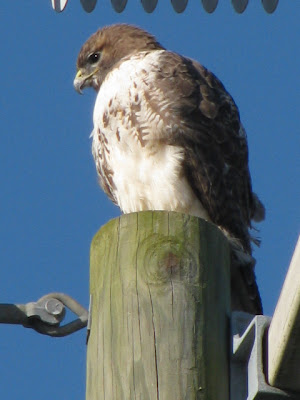
 Stopped and got out of my car when I spotted this magnificent hawk atop a utility pole.  Fortunately the highway wasn't too busy and I was able to manuever around and get a few decent shots of a gorgeous bird with a with a brilliant blue sky behind it.
Red-Tailed Hawk- its distinctive red tail feathers visible in these photos taken in August 2010 at the Point Reyes National Seashore near San Francisco.
Closer to home...

Went back to September 2010 for these photos I took of a Red-Tailed Hawk at Charleston's Magnolia Cemetery.
Hawks are rare to come across at the cemetery. I've seen a few fly over but to encounter one on a fairly low branch was very exciting.
And this one didn't seem to mind the human attention.
I wasn't able to get a real good shot of its distinctive red tail feathers but you can see them a little bit in the shot below.
 Recently at the wonderful Magnolia Plantation and Gardens, I saw this Red-Tailed in the petting zoo.
A little sad to see it in captivity like this.
But it does give the public a unique chance to see--and better appreciate- such a beautiful and majestic creature.
A little fuzzy, but here's a Red-Tailed in flight. Shot this along the new part of the Palmetto Commerce Parkway in North Charleston.

Friday, April 15, 2011

Great Blue Heron

Last but not least in my run of herons on this blog comes the Great Blue Heron, certainly the biggest and best known of this extended coastal breed. Over the past few years I've photographed the abundant Great Blue in a number of different places.  But perhaps my best shots, or at least the most close up I've been to this great bird was last November on Hilton Head Island where we gathered with family for Thanksgiving. 
A canal ran between a section of condominiums where some of our family members stayed on Hilton Head. This Heron seemed to be somewhat used to all the people being around and let me get pretty close.
Whether standing on one leg or two, the Great Blue is close to five feet tall.

Its wingspan can reach six and a half feet.
The color palette is varied.  You've got rusty-gray (neck), red-brown (thighs), black (plumes running from just above the eye to the back of the head), gray (lower legs), yellowish (eyes and bill), and white (face).
The colors add up to one elegantly beautiful bird that is much beloved, the Great Blue's image used in many company logos and advertising here in coastal South Carolina.

The class of the classy Heron family?  A tough call but I'd have to say yes.
Majestic but not aloof, based on my observations, the Great Blue Heron can be seen mixing with other big birds such as this Anhinga...
...and these Double-crested Cormorants.
The Great Blue Heron will always stand out in a crowd for its sheer size--and beauty.

Saturday, March 26, 2011

Little Blue Heron

New Little Blue Heron Photos
I went back to the old Kings Grant golf course and came across what I'm pretty sure is the same juvenile Little Blue I photographed there several weeks ago.  You can see how its color is changing, from all white (see below photos) to, eventually, all dark blue.  I plan to go back in coming weeks in hopes to see this heron again as its maturing process continues.
I shot the above photo in my cameras Vivid setting.  Almost looks like a watercolor!
Previous Posting
I was planning to next feature, as part of my recent heron spree, the Great Blue.  But last weekend I had a really neat encounter with a couple Little Blue Herons, so I decided to share these pictures first.
The Little Blue Heron is yet another of the Heron species that can be scene regularly in South Carolina's Lowcountry.  I took these photos at what used to be a golf course near my home.  This site has yet to be redeveloped and is returning to nature in many ways-- not a bad thing at all! 

The Little Blue is much darker than other Herons.  Its purplish neck is also distinctive as is its black-tipped bill.  Its also smaller than many of the other Herons. 
The big surprise for me at the old golf course was enountering an immature Little Blue which is more than a little white. 

When getting these shots, I wasn't sure what kind of bird I was seeing here. Looked little a Snowy Egret some but when it moved I wasn't seeing the Snowy's bright yellow "slippers."  Later at home I looked at my pictures and a few of my bird books.  It was then I noticed the same black-tipped bill as the adult Little Blue.

So this outing proved a first for me in that I had never seen a juvenile Little Blue Heron before.
 The Little Blue Heron is the only heron species in which first-year birds and adults show dramatically different coloration: first-year birds are pure white, while adults are blue. (source Cornell University's All About Birds website).
And quite a transformation it is!


Sunday, March 6, 2011

Tricolored Heron

I'm continuing my Heron run on BirdsEyeViews. My last two postings have been the Yellow-crowned Heron and the Black-crowned Heron. Now it's the Tricolored Heron's turn.

This bird is also or used to be called- depending on what you read- the Louisiana Heron.

What distinguishes the Tricolored from other Herons is its whte belly and the white stripe down the front of its neck. 
In the photo below, you see the Tricolored (right) next to a Little Blue Heron.  It's easy to differentiate between the two when you see them side-by-side like this.
I really like this next photo that captures, in a single frame, four of the most common coastal birds seen in South Carolina's Lowcountry.  From left, the Great Egret, Snowy Egret, Great Blue Heron and the Tricolored Heron.  This photo was taken, as are many of mine, at Charleston's Magnolia Cemetery.
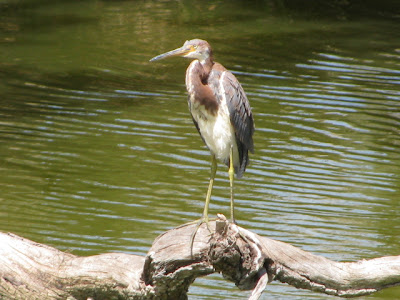
This next photo, I believe, is a juvenile Tricolored Heron.  The juvenile or immature one is described as similar to the adult, but more reddish.
Note the size of this young Tricolored's "feet."
I was curious about the Louisiana Heron name for this bird.  With some research, I've found the name goes back at least as far back as the 1830s when the legendary naturalist, painter and birder John J. Audubon himself wrote about seeing them in Florida. Somewhere over the years the more bland name of Tricolored was adopted.  Can I presume it's for the blue, gray and white colors of the adult? Please do correct if I am wrong on that point. 
I've been focusing on all of the different types of Herons to be seen in my area. And the one that's really most common, I have yet to feature: the Great Blue Heron, the mightiest and most majestic of them all. That will be my next posting. But let me finish this one with a couple more Tricolored (Louisiana!) Heron shots.
Gotcha!                      

What a lovely and graceful bird is the Tricolored Heron!

Added this photo on March 13, 2011-- A few days ago I photographed this Tricolored on a windy day.  A gust would really show off the plume that is usually pretty flat against the back of its head and neck.