Monday, February 11, 2013

Winter 2013 Backyard Birds

My backyard feeders have had plenty of customers the past several weeks as winter brings familiar feathered friends as well as some first-time visitors. The highlight, by far, was my sighting and photos of a Baltimore Orioles pair in my backyard bird bath.
A friend of mine who lives in another part of our neighborhood has attracted Orioles for several years with fresh grape jelly he keeps in a small bowl-like feeder. I've tried my own jelly but didn't have any luck. So I was pretty stunned- and thrilled- to look out the window one day and see these gorgeous Os in my own yard.
This proved to be a one-time sighting for me so I'm very pleased to have captured a couple nice images.
Another winter surprise has been the Yellow-rumped Warblers that have been coming around. These are quite common in our area but I've never had one at my feeders before this winter.
Rain or shine, the Warbler has been a frequent guest in recent weeks. Love the flashy yellow spots, not just on the rump but also on the breast and top of the head.
It's been a similar story with the Red-winged Blackbird. I frequently see them in nature settings, but until this winter, never at my feeders.
Blacky is always welcome at my backyard buffet. Another black bird has been also been an interesting and entertaining winter drop-in.
The American Crow isn't too proud-- but is almost too big-- to sample the tasty treats. At least the Crows only go to this larger feeder, leaving the smaller tubes and food dispensers to the smaller birds.
I was worried about the suet holder coming apart the way the Crow was pulling at it. Fortunately it held but the suet itself was going fast as Crow and Friends took turns at the trough.
The American Goldfinch, in winter colors, not its vibrant spring and summer yellow, has been a regular guest. They first came to the thistle sock you see in the background, but the Goldies likes to sample the rest of the menu as well. The black and white color scheme on the bird's wings and tail- just brilliant..even in the winter.
We've enjoyed seeing the American Goldfinch this winter and hope they'll return in the spring and summer with their signature yellow plumage.
The Red-bellied Woodpecker has also added some bright colors to our sometimes gray winter.
Red-belly is a year-round regular and I'm glad to have such a uniquely beautiful bird enjoy the suet I put out.
They're called Red-bellied Woodpeckers but that red head is The Bomb! The real Red-headed Woodpecker has nothing on this hairdo.
I have an excellent perch from an upstairs bathroom to photograph birds. There's a narrow window that opens up and out. I've taken out the screen, so that I can shoot directly and clearly down at the feeder, which is a short distance off the back porch.
Yellow-bellied Sapsuckers are part of the Woodpecker family...the eccentric uncle part, no doubt. I've had Sapsuckers come back to this one tree in my backyard for several years now.  You can see the holes they have made.
This bird amazes me how it blends so well into the texture and color of the trees it mines, or I should say, drills for food.
The Sapsucker is a truly unique bird. It's call is different from the other Woodpeckers too. Not the most photogenic bird around, but a really cool bird to see and hear in my yard. It's reliable in that it comes back year after year to this same tree.
Downy Woodpeckers are also perennial favorites. They too savor the suet. This one's a male, recognizable for the red on the back of his head.
The Downy isn't always down with me taking pictures! But I've found this bird isn't as, well, flighty as other types. I can walk within feet of the feeder and the Downy won't fly away.
It was nice to capture a quality image of South Carolina's state bird, the Carolina Wren. This bird is such a little beauty, with delicate, striking features and a plucky, vocal disposition, kind of like the Palmetto State itself.
The little Chipping Sparrows have been the most abundant bird this winter. They really are beautiful. Good things come in small packages, just ask the Carolina Wren.
The red strip on the top of the head is a signature Chipping Sparrow mark. Thanks for showing me your markings so clearly little sparrow!
I just added this next Chipping Sparrow photo. This guy (or gal) was on the ground right outside my back porch door. Didn't look sick but it may have been. It sat still like this for some time before finally flying to a nearby bush. Hope nothing too wrong. I do like this image because he can really see the many layers of feathers Chip has.
The one-of-a-kind looking Tufted Titmouse is a year-round regular at my feeders.
This bird is always stylish with its poofed up 'do.
The Brown-headed Nuthatch (seed in beak) doesn't come around too often. This one did while I was sitting, just a few feet away on my back porch, camera in hand. Thanks for the pix Brownie!
 
I was stumped by this next bird. WhatBird.com's bird ID forum helped me...again. It's a female Brown-headed Cowbird.
This bird is disparaged a good bit, called a nest parasite, among other things. The reason is because they lay their eggs in the existing nests of other birds, then abandon the eggs, leaving the hatching and care to other birds. Not cool Brown-headed Cowbird! Your name is not very attractive, nor is this behavior!
So far this winter I haven't seen the male Brown-headed Cowbird, which, as the name implies, has a dark brown head and neck.  The body and wings are black.
These next birds I also had trouble indentifying due to the white tail feathers. Turns out they are "just" Northern Mockingbirds doing some kind of ritualistic "dance." I couldn't tell if they wanted to mate or fight. I took some video of some other Mockingbirds doing the same thing recently. I put something together that's on YouTube.  Hope David Bowie doesn't mind me using his great "Let's Dance" song.
I'll add more winter backyard birds as I see them and photograph them! (I just did!)
Wow! I go outside to get my mail and two beautiful Red-shouldered Hawks fly by and land on a gumball tree two houses down from mine. I went inside, grabbed my camera, and thank goodness they were still there! I got this shot of the pair, before one flew away.
I like the pose here and also the gumballs. When the birds first landed minutes before they were all over each other.  Today is Valentine's Day after all!  Love is in the air!
 
Such beautiful feathers and coloring. I wish one of those tail feathers had fallen to the ground.
I justed add this next photo on Feb. 21 of a Downy Woodpecker and a Carolina Wren sharing a big block of yum-yum!

Here's the male Downy Woodpecker by itself in an extreme closeup.
Getting a good full-bodied shot is always challenging.
I like this one too! The Downy isn't still for long. I had to shoot several times to get these.
All for now...


Tuesday, January 1, 2013

Donnelley Wildlife Management Area

Happy New Year! I hope you have many enjoyable nature outings and adventures in 2013.

We are fortunate in South Carolina to have several wildlife refuges in the state's Lowcountry. Several are former rice plantations located in the ACE basin.  This is a large protected region named for the confluence of three rivers, the Ashepoo, Combahee and Edisto.

I've posted previously on some of the other locations that are part of this system: Bear Island and the Hollings National Wildlife Refuge, for example. The other day Alesia and I drove down to the Donnelley Wildlife Management Area (WMA) in remote Green Pond, S.C.
I had been to Donnelley a few times before. This was the first time in the winter, and it proved to be the best as far as the abundance of birds. We first saw a number of Common Moorhens in a swamp a short ways from the entrance to the 8,000 acre preserve.  Whatbird.com describes the Moorhens as a chicken-like marsh bird distinguished by the red shield-like plate above its bill. It also has a distinctive yellow tip on its bill.
Donnelley has a large pond that, on this day, had a nice variety of birds in and around it, including these Great Blue Herons. This large bird, always so photogenic and picturesque, was especially so with the neat reflections and when they passed or stood near each other.
This next shot looks like it was done in time elapsed exposure. It wasn't. It's two Great Blue Herons and a neat reflection.
On a small island there were a number of Black-crowned Night Herons, many of which seemed to be in slumber mode.
We tried to be quiet so as to not wake or disturb them!
The juvenile of this species looks so different than the adults. What a beautiful plummage and eye coloring the young ones have! 
I also liked this pair of Boat-tailed Grackles. They were very busy with lots of calling and keeping their bills to the sky.

Sunday, December 16, 2012

Successful Saturday Signing! And a Lifer Bird Too!

My Saturday, Dec. 15 book signing went really well! Thanks to those who came out and bought my Birds of Magnolia Cemetery book.  It's always nice to meet fellow bird and nature lovers!  Thanks also to the cemetery's super superintendent Beverly Donald for making this event possible!  
My next signing is this Wednesday, Dec. 18 at the College of Charleston. I'll have a table on Cougar Mall in front of the Robert Scott Small building from noon- 2. Call or text me at 843.224.3112 if you need help with directions.


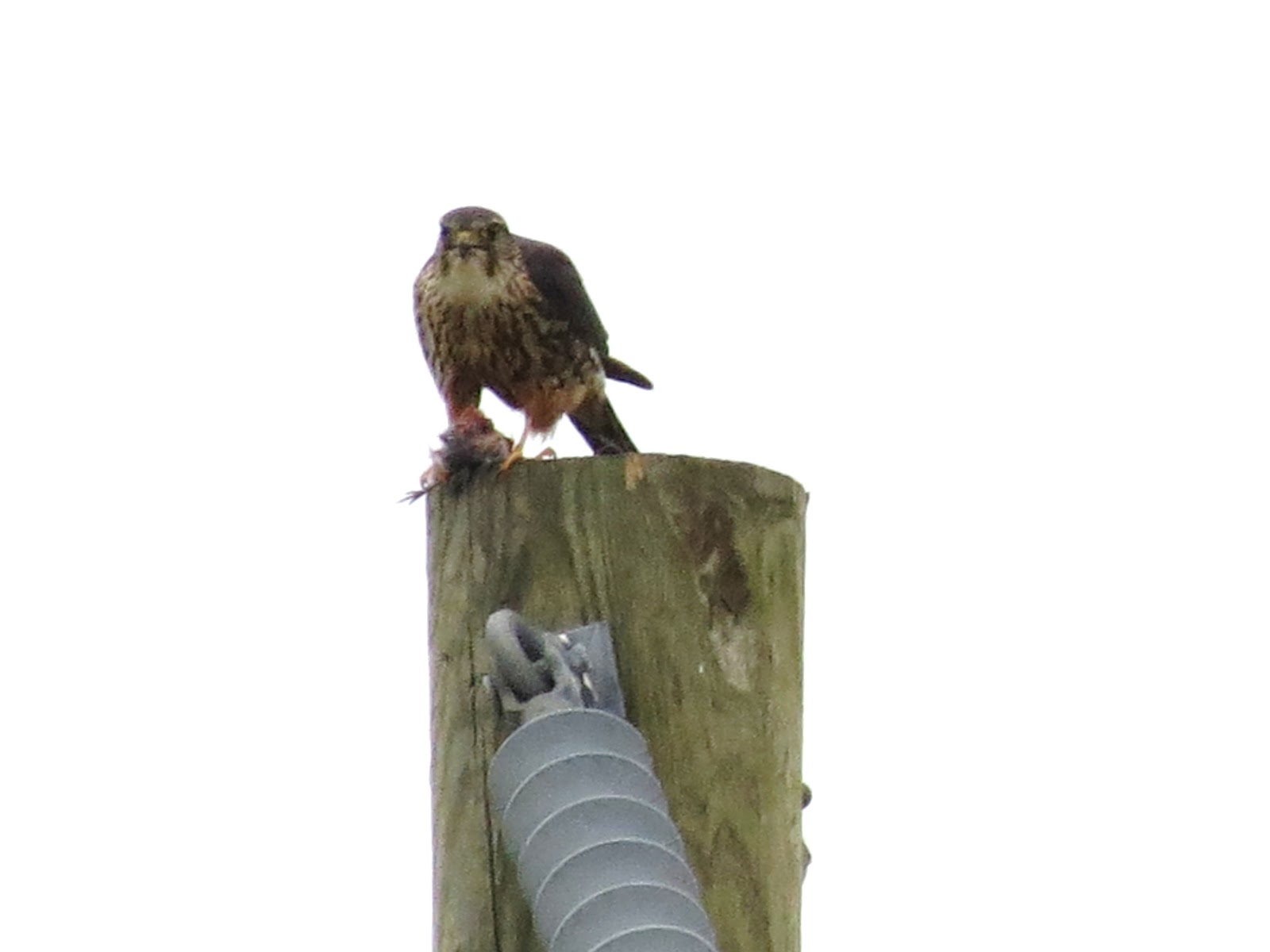
You know I never go to Magnolia Cemetery without my camera. And I'm sure glad I did as I scored some nice photos of a Merlin (which I originally thought was a Hawk). Merlins are members of the Falcon family. 
 
Through my lens and binoculars it was hard to tell what the Merlin had caught and was eating. It wasn't until I got home and viewed the shots on my television and computer that I determined it was a bird. The Audubon Field Guide online confirms that Merlins feed mostly on small birds captured in high-speed mid-air pursuit. That is what Falcons are known for.


OK last carnage shot, not trying to gross out people!


I am updating this post in July 2024. I came across these photos and this old post while this summer updating my "Birds of Magnolia Cemetery" book. Pretty cool to discover a "lifer" bird 12 years after the fact! 
  

Monday, November 19, 2012

Book Signing Set for Saturday, Dec. 15


                                             Click above to see a YouTube video about Magnolia Cemetery!

Here's an idea for a unique and classy holiday gift!  I will be signing copies of "The Birds of Magnolia Cemetery: Charleston's Secret Bird Sanctuary" on Saturday, Dec. 15, from 10 a.m.-1 p.m.  The location will be, where else?  Magnolia Cemetery.

What an unusual place for a book signing, I know.  But it makes perfect sense given the book's subject:  how this beautiful and historic cemetery is an unlikely haven for many types of birds, year-round.


The book is 130-pages, featuring more than 400 color photographs of nearly 50 different types of birds, all found in the intimate and offbeat setting of Magnolia Cemetery, founded in 1850.  The cemetery is a "who's who" of Charleston history and also has a large Confederate representation with the graves of more than 1,700 men who fought and served in the great war.


What surprises many people is how Magnolia Cemetery is also a haven for a wide variety of birds. Two ponds, nearby salt marshes, the Cooper River, and the cemetery's quiet and peaceful location make for a thriving ecosystem that attracts a wide array of birds from large herons, egrets, wood storks and osprey to smaller birds and ducks such as belted kingfishers, yellow-rumped warblers, mallards and hooded mergansers.

Longtime Magnolia Cemetery superintendent Beverly Donald endorsed the book, saying: "The efforts put forth by Patrick Harwood in composing this book draw you in and invite you to join his experiences at Magnolia Cemetery. I feel this book would be a wonderful addition to everyone's collection."  (An interview with Donald about her years running Magnolia Cemetery can be read here.)

Published by BirdsEyeViews and printed locally by Knight Printing and Graphics, the book sells for $29.95 (two for $55).  Only checks and cash will be accepted at this signing event.

Magnolia Cemetery is located at 70 Cunnington Ave., which is off Meeting Street Road near Morrison Drive and Santi's restaurant. For directions, call the cemetery at (843) 722-8638.


For more information about this event or to purchase the book, contact me, Patrick Harwood, at 843.224.3112, magnoliacemeterybirds@hotmail.com, or (leave a comment or question on this blog. I hope to see you on Saturday, Dec. 15 at Magnolia Cemetery.


A Yellow-Crowned Night Heron Takes Flight at Magnolia Cemetery
I am also excited to report that I am working on a second book about Magnolia Cemetery. This one is about the unique cemetery art there, in terms of the many magnificent monuments and markers. The book will feature photographs and descriptions about many of the most striking gravesites and there will be stories about the people buried beneath them.

I am hopeful this book will be finished by the end of 2013 or early 2014.  See more details about this book here.

(Added 2013) Click here to see a short slideshow showing some of the magnificent memorials featured in my new book!

Links:  Cemetery Superintendent Interview
           Magnolia Cemetery Slideshow
           Magnolia Cemetery Timeline
           Video: Patrick Harwood's Magnolia Cemetery Bird Book
           Video:  Osprey- Gone Fishing
           Carolina Nature Photographers Association (I'm a member!)


Saturday, October 27, 2012

Eastern Phoebe

I spotted this cute little bird last weekend at the old Kings Grant Golf Course. I needed some identification help and again received prompt and accurate replies after I posted two photos on the WhatBird.com forum that helps people identify mystery birds.


I first thought that this small bird may be a Warbler and was later surprised to realize it is in the Flycatcher family.
I didn't hear its call but that's where the name Phoebe comes from, the "Fee-bee" sound it makes, according to the write up on this bird on WhatBird.com.

Another neat fact is that a group of Eastern Phoebes is called, among other names, an outfield.  Catching flies as a baseball outfielder would-- get it? 

The state (and fate) of the former Kings Grant golf course has been in limbo for years. But this summer Wachovia/Wells Fargo bank sold it to an out-of-state developer. I am hopeful, as are residents in the Kings Grant neighborhood, that part of the old golf course will be left alone or turned into a nature park.

In June I had a letter to the editor published in the Charleston Post and Courier sharing my views on this issue. I know it has been widely circulated in the neighorbood (because someone contacted me some weeks later and asked my permission to copy the letter to share with residents there.)
The link to my letter doesn't include the photograph that ran with it in the newspaper.  It was of a pair of Red-shoulder Hawks I photographed at the old golf course a while back.

Aren't they beautiful? Since the golf course closed several years ago, there has been no development on the land so it has reverted back to nature and has become a really neat bird refuge of sorts.

Let's hope the new owner sees the benefits of keeping part of the property along the Ashley River as a park with access to not just Kings Grant residents but the rest of the community as well. 


Sunday, October 21, 2012

Welaka, Florida Fall Visit

Alesia and I were in Welaka, Fla. a couple weekends ago visiting her sister and her husband who have a second home on the St. Johns River.  It was our first time there and we really enjoyed the lovely scenery, especially this amazing sunset one evening!
These weren't storm clouds just a very striking confluence of colors at sunset made even more spectacular by the reflection in the river.
Welaka, population approximately 600, is a small river town in Putnam County, about 90 miles southwest of Jacksonville.
Ron and Suzan took us on a fun morning outing in their boat.
Me being me, I had my eye out for birds along the river.  Osprey are abundant in the area, near the river...
...and in town on a TV antenna.  I didn't know people still used these!
Osprey have amazing yellow eyes that do not miss a thing- or a person like me taking its picture.
Along that same residential road I had to jump out of the car again when seeing this Red-shouldered Hawk on a powerline.
Hawks have some powerful eyes too.
Another stop-the-car moment was when we passed these two large birds near the Welaka State Forest.
Initally, I thought they were Great Egrets or Great Blue Herons, but then did a double-take when I noticed the red markings on their faces.
These are Florida Sandhill Cranes, a "lifer" bird for me, meaning this was the first time I ever saw one.  I can't say I had ever heard of this breed.  But that's what makes going to new places neat, the opportunity to see new things, including birds and ducks. How about the crane's orange eyes!
Speaking of orange, this lovely butterfly caught my eye during our visit to the Welaka State Forest.
Saw some Common Moorhens in a murky swamp at the park.
A Great Egret stood tall for this photograph.
We really had a nice time in Welaka, Fla., a true fishermen's paradise.
The birding was good too.
The scenery was special!
But the real treat was the fine food at my brother-in-law Ron's new restaurant, R&B Welaka BBQ. He and two partners have opened a delicious barbecue restaurant in this small town. If you're ever in the area, be sure to stop in.  You'll love it too I am sure!
That's Ron on the left with the other two owners.
Thanks for a great visit Suzan and Ron!
Florida- the Sunshine State where the sunsets aren't bad either!